Huh? Cherry blossoms already on Horikawa Street? Is it blooming early because of the warm winter?
Posted date:2026-01-09Author:Tsubakuro
Transrator:Ponta
Category:Talk about Kyoto
広告
adsense4
To begin with
It was when I exchanged New Year’s greetings with an acquaintance at the start of the year.
The conversation naturally turned to the safest topic: the weather.
“This winter’s been unusually warm, huh? Spring might come early this year.”
“Yeah, you’re right. Maybe the cherry blossoms are already blooming around here…”
“No way. Today’s still Seven Herbs Day, after all.”
“True, it’s not even Little New Year yet.”
And so, we laughed as we talked about warm winter and the cherry blossoms.
That afternoon, I happened to have errand taking me toward the Horikawa Marutamachi area.
Walking along Higashi-Horikawa Street, I glanced absently at the trees lining the riverbank…
Anyone from Kyoto knows this, but along Horikawa Street, the cherry blossom trees stretch endlessly from Imadegawa in the north to Oike in the south.
Not only the most common Somei-Yoshino cherry trees, but also late-blooming double-flowered varieties, weeping cherry trees, mountain cherry trees, and early-blooming Kawazu cherry trees – over a dozen varieties in total – are planted here, making it a relatively large collection and a hidden cherry blossom spot.
Well, as I walked along that seemingly endless row of cherry trees that day, my gaze suddenly became fixed on one particular tree.
That’s this one.
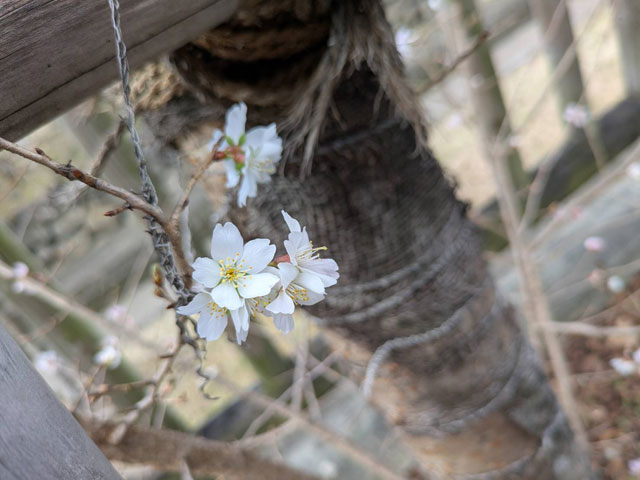
Shikizakura flowers
“Cherry blossom? Are they blooming?”
I couldn’t believe my eyes, but they were definitely cherry blossoms.
“Maybe it bloomed out of season because it was too warm…”
I couldn’t help but feel curious, so I decided to go back the next day and take a closer look.
The true identity of the cherry blossom is the Shikizakura.
The following day, January 8th.
I made my way back to Horikawa Marutamachi.
Wandering along Higashi-Horikawa Street, I found them – ah, they were definitely blooming!
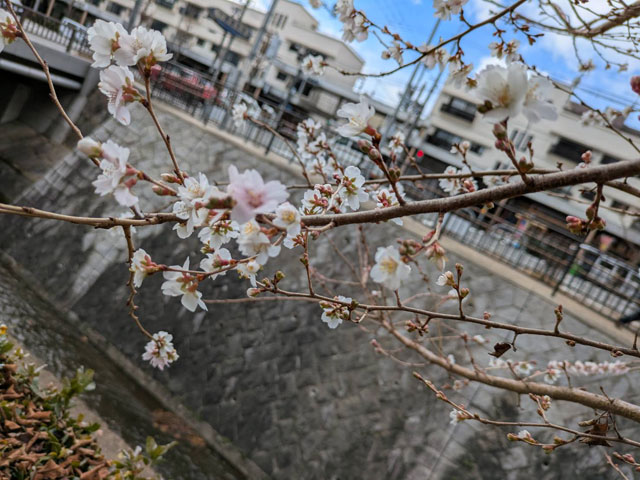
Shikizakura blooming on branches
Morever, it’s not just one that’s blooming.
From Shimodachiuri in the north to Takeyamachi in the south, spanning roughly 300 meters, there were a total of five trees in bloom.
However, even for the cherry blossoms, they are not exactly showstoppers.
The trees stand at just under five meters tall.
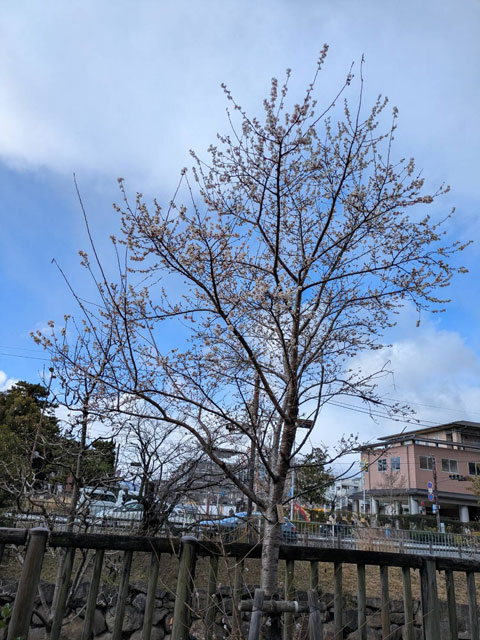
Total length of the Shikizakura

Shikizakura with flowers on its branches
Though it has bloomed to a certain extent, it’s hardly what you’d call in full bloom.
The petals are small, and the color is a pale white tinged with gray.
It’s rather plain and poor-looking cherry blossom, if anything.

Close-up of Shikizakura flowers
— I’ve never seen this variety before. What kind of cherry blossom is this?
As I approached the tree to confirm its name, a name tag was affixed to the trunk, reading “Shikizakura.”

The name tag for the Shikizakura attached to the trunk
— Is this the same group of cherry trees as the Kawazu-zakura, known for blooming early?
Having long been interested in cherry blossoms, I had read several books by the renowned cherry tree guardian, the late 16th-generation Sano Toemon, who passed away last year at the age of 97. I was greatly captivated by this Shikizakura I had only just learned about.
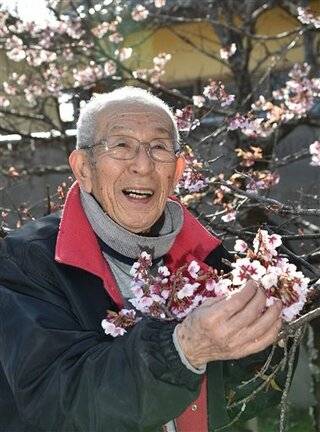
Cherry tree guardian Mr. Sano Toemon
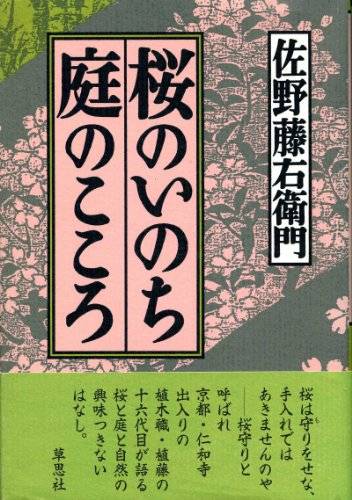
“The Life of Cherry Blossoms, The Heart of the Garden”
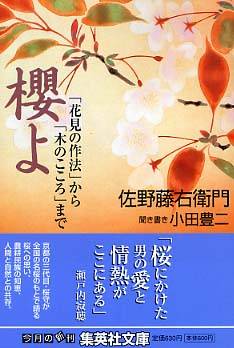
“Oh, Cherry Tree”

“Talk with Trees”
Seeing the winter-blooming shikizakura was another reason I wanted to learn more about cherry blossoms. — With that in mind, I learned all sorts of things from the curator in charge of cherry blossoms at the Prefectural Botanical Garden.
Interview with a Curator at the Prefectural Botanical Garden: The Story of Cherry Blossoms
— Recently, I saw some Shikizakura cherry blossoms blooming along Higashihorikawa Street. What kind of cherry blossom is that?
“Shikizakura, you say? Shikizakura is a type of cherry blossom characterized by blooming twice a year, in spring and autumn?” This is a cherry blossom from the group of winter-blooming cherry trees that flower two seasons a year. There are other types of winter cherry blossoms too, like the Jugatu-zakura, Koba-zakura, and Kobuku-zakura are famous ones.”
—- So, does it mean the early-blooming cherry blossoms didn’t bloom out of season because of the warm winter?
“Yes. It’s not like they’re early-blooming varieties blooming out of season or anything. Shikizakura bloom once in spring, then bloom again during the autumn foliage season. After that, if it’s a warm winter, they keep blooming here and there as a lingering trace of autumn.”
— Mr. Sano Toemon, the cherry tree guardian, writes that new varieties of Sakura are born every year, but is Shikizakura also a recently hybridized variety?
“No, Shikizakura itself has been around since the Edo period. It’s just that for a long time, when people thought of sakura, they strongly associated it with blooming in spring, right? That’s why double-blooming cherry trees weren’t planted very often. Only recently have people gradually become aware that there are early-blooming and late-blooming varieties. — People have gradually come to understand that cherry blossoms aren’t just for spring, so winter cherry varieties like Shikizakura have started being planted around here lately.”
— I took a good long look at the Shikizakura, but it doesn’t look very impressive, does it? Even it’s blooming, it’s like it’s quietly hiding from view, you know…
“Well, you know, the petals are especially small in autumn and winter. They’re a bit larger in Spring.”」
— That Shikizakura I saw by Higashihorikawa, the one planted alongside the Somei Yoshino and double-flowered cherry trees there – is that also a cultivated variety? I mean, is it a clone propagated by grafting?
“That’s right. It’s a horticultural variety. And it’s a clone propagated by grafting.”
— What on earth makes that lackluster Shikizakura a garden variety for ornamental purposes? As far as I can tell, it doesn’t look particularly impressive unless you have something like autumn foliage mountains in the background.
“That’s right. They look beautiful blooming amidst the autumn leaves. That’s why nationally famous Shikizakura spots like Gunma Prefecture’s “Sakurayama Park” or Toyota City, Aichi Prefecture’s “Obara Shikizakura” both have around 10,000 or 5,000 trees planted amidst autumn foliage mountains. Enjoying them alongside the fall colors is the whole point.”

Gunma Prefecture’s Shikizakura and Mountains Ablaze with Autumn Colors
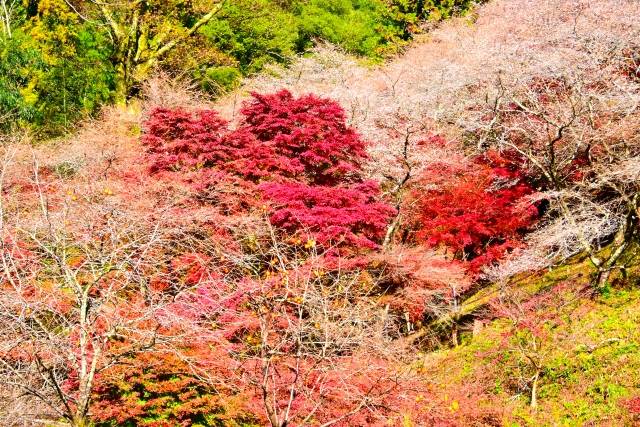
Aichi Prefecture’s Shikizakura and Mountains Ablaze with Autumn Colors
— Where in Kyoto are they planted?
“They’re usually along the roadside or just sitting there in the middle of a park. The lifespan of the Somei-Yoshino cherry tree, which is like the proper name for cherry blossoms, is about 50 years. After the Somei-Yoshino trees die, Kyoto City plants Shikizakura instead. That’s why, honestly, I don’t think it stands out much at all. Especially the Shikizakura in winter, when the surrounding trees are dead.”
— Reading Mr. Fujiemon’s book, he repeatedly states that cherry trees grown from grafting lack individuality, are uninteresting, and lack the inherent qualities each tree should possess. But from what I’m hearing now, aren’t most of the cherry trees we see clones of horticultural varieties. The kind of cherry blossom Mr. Fujiemon envisioned – one where the petals hold nectar, attracting insects for proper pollination, then bearing fruit that birds peck at, dropping seeds to the ground where they sprout…That kind of cherry blossom is hard to find in the city, isn’t it?
“That’s right. Once it becomes a horticultural variety, it can no longer produce nectar in its petals. If that happens, there’s no pollination, no fruit. They simply won’t grow from seed. The only way is to graft them by hand and increase their numbers.”
—Mr. Fujiemon often said during his lifetime that the Somei Yoshino cherry tree was the prime example of that, didn’t he?
“That’s absolutely true. Somei-Yoshino cherry trees are well-suited for grafting, or rather, they’re cherry trees that are easy to grow from grafts. It’s hassle-free, so as you know, it’s now spreading all over Japan. But in exchange, since every flower is a clone, they’re all uniform and completely lack individuality.”
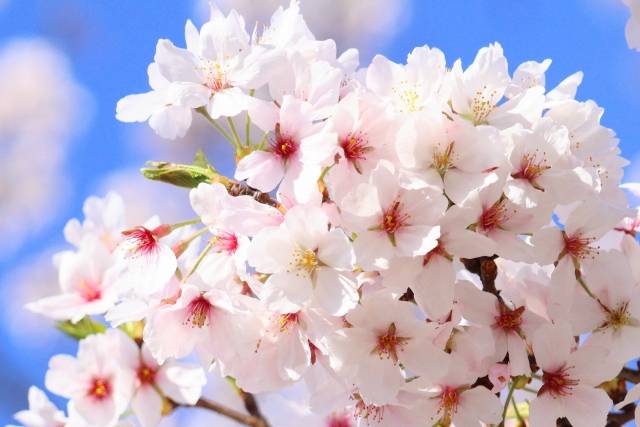
Somei-Yoshino cherry tree
— So then what kind of cherry blossom does Mr. Fujiemon consider ideal?
“I think the quintessential example is a solitary mountain cherry tree standing tall amidst the mountains, blooming magnificently. Those cherry trees bloom in different colors each year, delighting visitors. We leave everything to nature’s course.”
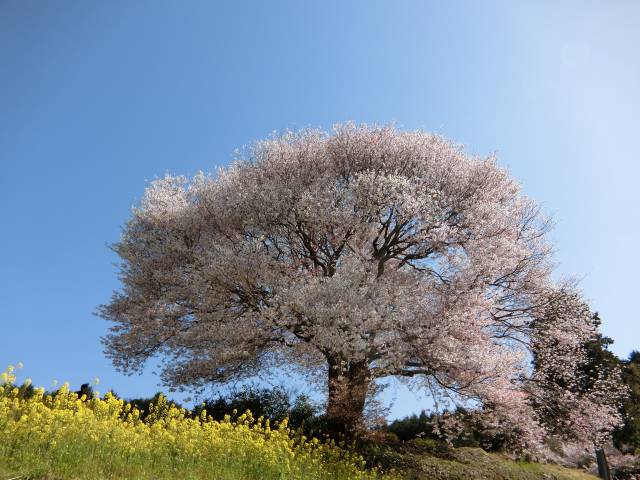
Mountain cherry blossoms blooming amidst the great nature.
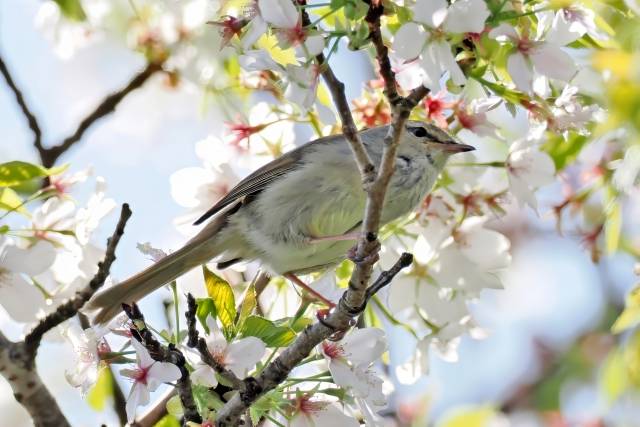
Mountain Cherry Blossoms and a Wild Bird
— What is the most famous cherry tree in Kyoto that was grown from seed?
That famous weeping cherry tree in Gion’s Maruyama Park. That one originally inherited the life of a cherry tree that had been passed down since the Edo period. The original famous tree from the Edo period, which was 220 years old, died in 1947. But before it withered away, the father of Mr. Fujiemon, who passed away last year – that is, the 15th-generation Sano Fujiemon – had collected just six seeds from that original cherry tree and nurtured them with great care in his own hands. The sampling grown from that seed was planted in Maruyama Park in 1949, and that is the weeping cherry tree you see today. In other words, the current weeping cherry is the second generation. It’s been nearly 80 years old since it was planted, but it’s still going strong.”
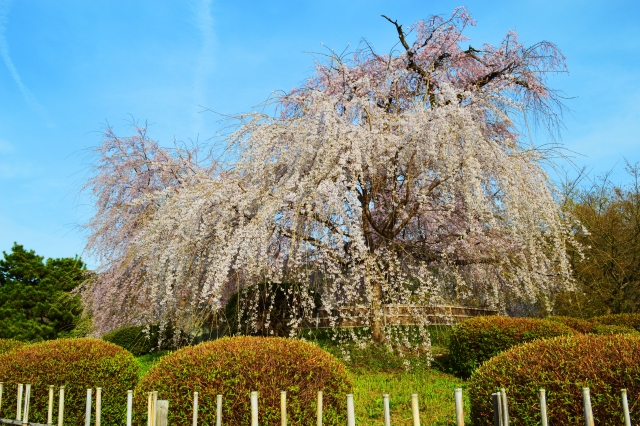
The weeping cherry tree in Maruyama Park
— So what happened to the remaining five seeds?
“One seed became the large weeping cherry tree blooming in our prefectural botanical garden. The remaining seeds are being carefully nurtured at Mr. Fujiemon’s place, you know. That’s why the cheery trees at Maruyama Park and the botanical garden are siblings, you see.”

The large weeping cherry tree in the prefectural botanical garden
“Also, you know, the seedling grown from the seed of the current second-generation weeping cherry tree at Maruyama Park was planted by the late 16th-generation Mr. Fujiemon at the rotary in front of Nijo Station’s east exit back in 1998. It continues to bloom beautifully every year. This makes it the third generation to carry on the legacy of that famous tree from the Edo period.”
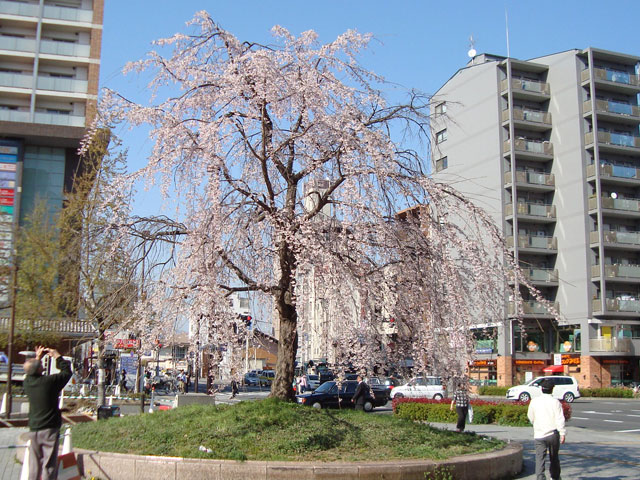
The weeping cherry tree in front of Nijo Station East exit
— Do you still think that cherry trees nurtured with such care from seed possess a beauty distinct from clones?
“Yes, I still think so. Mr. Fujiemon often told us curators at the botanical garden during his lifetime that plants are fascinating because each one is different. People are the same. Everyone has their own quirks, which is what makes them interesting. Cherry blossoms are the same. Certainly, Somei-Yoshino cherry trees are easy to graft, and once planted, they bloom simultaneously everywhere. But ultimately, it’s nothing more than artificial beauty. I agree. Cherry trees grown from seed are truly something else. The land’s climate is important, the weather is important, and the birds, insects, and other creatures are important. That’s why, even when we talk about cherry blossoms, they are incredibly deep and fascinating. I sincerely hope more people will visit our Prefectural Botanical Garden.”
Conclusion
As described above, encountering the unfamiliar Shikizakura variety led to an unexpected conversation with a curator at the Prefectural Botanical Garden.
Now, regarding Mr. Sano Toemon, whose name frequently came up in our discussions with the curator, I’ll briefly introduce him here.
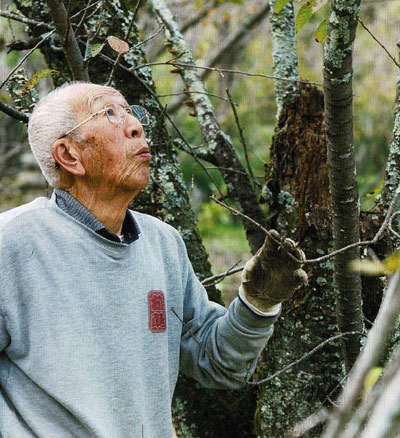
Mr. Sano Toemon
Sano Toemon is the name of a family of gardeners who have been involved in the landscaping of Ninnaji Temple since the Edo period.
Their connection with cherry trees began with the 14th generation.
The 14th-generation Fujiemon began researching cherry blossoms after becoming involved with the work at the Prefectural Botanical Garden during Taisho era.
The 15th-generation Fujiemon who succeeded him is said to have supported Japan’s postwar recovery during the chaotic period with cherry blossoms.
In particular, he became famous for hugging the newly planted weeping cherry samplings in Maruyama Park to prevent them from collapsing when Typhoon Jane struck Kyoto directly the very next year, 1950.
His son, the 16th-generation Fujiemon, dedicated himself to cultivating cherry trees throughout Japan. His achievements in discovering and introducing new cherry varieties – including the weeping cherry at Maruyama Park, the Kenrokuen Kiku cherry, the Ichihara Toranoo cherry, and the Oosawa cherry – and spreading them.
Even after turning 90, he continued to travel energetically across the country, watching over cherry blossoms in various regions. However, he passed away last year at the age of 97 due to old age.
He remained active throughout his life, captivating many with his unpretentious character.
Finally, I’ll briefly share what I felt upon revisiting Sano Toemon’s books once more.
They bloom to connect with the land and to sustain life.
From Kyushu to Hokkaido, from the Pacific coast to the Sea of Japan coast, each region has its own distinct climate and natural features.
And the animals that live there differ depending on the climate and environment, as do the insects.
They all live by adapting to nature.
When they can’t adapt, the plants wither away.
Animals are declining in number.
All exist while maintaining balance with nature.
Cherry blossoms are the same.
And so are humans, are they not?
I cannot help but feel that throughout his life, the 16th-generation Sano Toemon who poured his profound passion into cherry blossoms across Japan was constantly sounding the alarm: “Have we not begun to forget that humans, too, are but one existence within nature?”
References
1: The Life of Cherry Blossoms: The Heart of the Garden” by Sano Toemon, 1998
2: Oh, Cherry Blossoms” by Sano Toemon, 2004
3: Talks with Trees” by Sano Toemon, 1999

Author

Tsubakuro
I was born and raised in Kyoto and am a native Kyotoite.
When I was young, I longed to visit Tokyo and Osaka, which are more bustling than Kyoto, but as I have gotten older, I have come to appreciate Kyoto a little more.
In this site, I will introduce you to some of the best places to explore Kyoto's food that you might otherwise miss at first glance.